R-22 Refrigerant Phase-Out Guide Canada
Everything GTA condo corporations and property managers need to know about R-22 refrigerant — what it is, why it's banned, what to do if your building still has R-22 equipment, and what replacement options are available.
R-22 Refrigerant in Canada: The Complete Guide for GTA Building Owners
R-22 refrigerant — also known as HCFC-22, Freon, or R22 — was the dominant refrigerant used in residential and commercial HVAC equipment for decades. In Canada, the production and import of R-22 refrigerant was completely banned as of January 1, 2020 under the federal Ozone-Depleting Substances and Halocarbon Alternatives Regulations, implementing Canada's commitments under the Montreal Protocol. If your GTA condo building or commercial property still has equipment running on R22 refrigerant, you are operating on borrowed time — and you need a plan. For related compliance information, see our HVAC refrigerant management guide.
What Is R-22 and Why Was It Banned?
R-22 refrigerant is a hydrochlorofluorocarbon (HCFC) compound used as the working fluid in the refrigeration cycle of air conditioning systems, heat pumps, and some refrigeration equipment manufactured before approximately 2010. It was widely used because it performed well, was relatively non-toxic, and was easy to handle. However, R-22 contains chlorine atoms that, when released to the atmosphere, rise to the stratosphere and catalytically destroy ozone molecules — the same ozone that protects the Earth's surface from harmful ultraviolet radiation. The ozone depletion potential (ODP) of R-22 is 0.055, meaning it destroys 5.5% as much ozone as an equivalent mass of CFC-11 (the original benchmark refrigerant).
Canada phased out R-22 production and import through a graduated schedule mandated by Environment and Climate Change Canada. The final ban on production and import took effect January 1, 2020. Existing stockpiles (including refrigerant recovered and reclaimed from old systems) can still be legally used for servicing existing equipment — but supply is extremely limited, prices are very high, and availability will continue to decline as stockpiles deplete.
Does Your GTA Building Still Have R-22 Equipment?
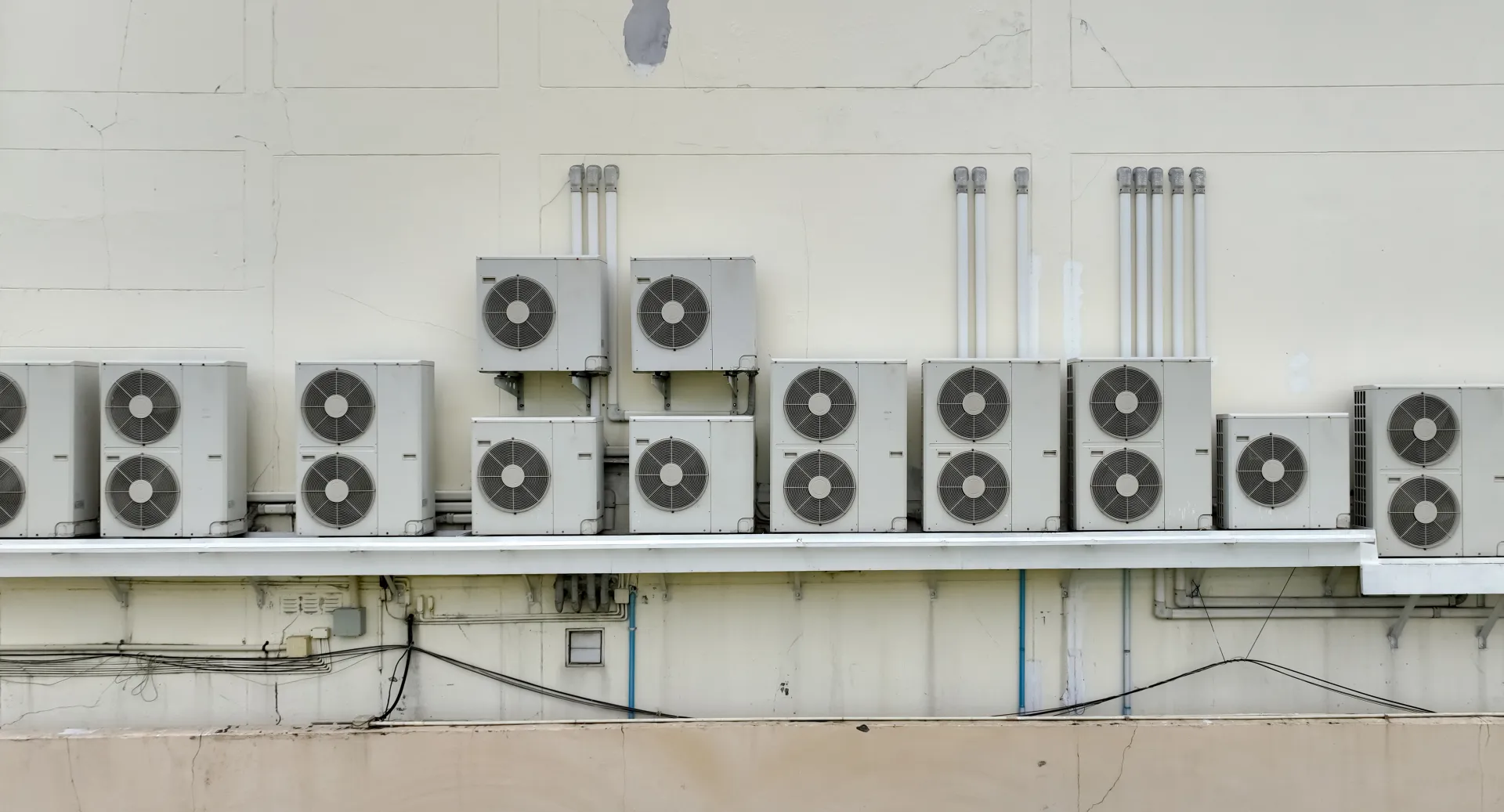
In the Greater Toronto Area, many condo buildings constructed between the 1970s and early 2000s still have HVAC equipment that uses R-22 refrigerant. The most common R-22 equipment found in GTA condo and commercial buildings includes:
- Water-source heat pumps (common in condos built 1985–2005) — many ClimateMaster, Florida Heat Pump, Mammoth, and early Carrier water-source units used R-22.
- Rooftop packaged units (RTUs) serving commercial spaces, retail pads, and building amenity areas.
- Split air conditioning systems in older suites, management offices, and amenity spaces.
- Make-up air units with DX cooling coils installed before 2010.
- Centrifugal and reciprocating chillers in older mechanical rooms (some larger commercial chillers used R-22 or the closely related R-11 and R-12)
To confirm whether your equipment uses R-22, check the nameplate on the outdoor unit (for split systems) or the equipment tag (for packaged units). The refrigerant type is listed as "Refrigerant" or "Refrigerant Type" on the nameplate, or may be visible on the charging port fittings. If uncertain, our technicians can confirm the refrigerant type during a service visit.
The Real Problem: Servicing R-22 Equipment in 2026
The immediate issue for buildings with R-22 HVAC equipment is not legality of operation — you can legally continue running equipment that uses R-22. The problem is what happens when the equipment leaks or needs a top-up. Since January 1, 2020, no new R-22 has been produced or imported in Canada. The only legal source is recovered and reclaimed refrigerant from decommissioned systems, which is certified under the Environmental Protection Act.
Reclaimed R-22 refrigerant that was trading at $10–15/lb in 2015 now commands $60–100+/lb in 2026 — when it can be found at all. A typical water-source heat pump in a GTA condo might have a 5–8 lb charge, meaning a simple top-up that cost $75 in 2015 now costs $300–800. For a large rooftop unit with a 20–50 lb charge, a single service event can cost $1,500–$5,000 in refrigerant alone.
More critically, if a major leak occurs — a failed coil, cracked line set, or damaged valve — the cost to recharge a large R-22 system may exceed the replacement value of the equipment itself. At that point, you face an emergency replacement with no time for planning, permitting, or reserve fund preparation. Our emergency HVAC services team handles these situations, but planned replacement is always less expensive.
R-22 Refrigerant Replacement Options for GTA Buildings
Building owners with R-22 equipment have three main options:
Option 1: Continue running until failure, then replace
This is the default approach for many buildings. The risk is unplanned emergency replacement at elevated cost, potential for extended downtime, and the possibility of water damage from a failed heat pump. If your R-22 equipment is in good condition and has no history of leaks, this may be acceptable — but have a replacement plan and budget ready.
Option 2: Retrofit to a drop-in R-22 replacement refrigerant
Several alternative refrigerants — including MO99 (R-438A), RS-44b (R-452B), and Freon MO29 (R-422D) — are marketed as drop-in replacements for R-22. These can extend the useful life of existing equipment without replacing the unit. However, capacity and efficiency change with the new refrigerant, the equipment was not designed for these alternatives, and not all manufacturers endorse retrofits. This option is generally best for equipment in good condition with 3–7 years of useful life remaining where full replacement is not yet economically justified.
Option 3: Proactive replacement with modern equipment
The best long-term strategy is planned replacement of R-22 equipment with modern units using R-410A, R-32, or R-454B refrigerants. Modern water-source heat pumps, ductless mini-split systems, and commercial rooftop units offer 30–50% better efficiency than equipment from the R-22 era, significantly reducing energy costs over the replacement's operating life. For condos with many R-22 water-source heat pumps, a phased HVAC system upgrade program can spread capital cost over several years while eliminating the R-22 dependency building by building.
R-22 and Ontario Rebate Programs
Replacing R-22 equipment with high-efficiency alternatives can qualify for significant Ontario and federal incentives. The Canada Greener Buildings Initiative and Enbridge conservation programs both support energy efficiency improvements in commercial buildings, including HVAC equipment upgrades. If your building is replacing R-22 water-source heat pumps with modern equivalents — or converting to a different system type — a professional energy audit can document the efficiency improvement and establish eligibility for available programs. See our Ontario heat pump rebate guide for current program details.
What to Do Next if Your Building Has R-22 Equipment
Start with a complete inventory of all R-22 equipment in your building — units, locations, capacities, ages, and current condition. HVAC Touch provides R-22 equipment assessments for GTA condo corporations and commercial property owners, giving you a clear picture of your risk exposure and a prioritized replacement plan that can be incorporated into your reserve fund study. Contact us at (905) 618-0075 or request a free assessment online.
R-22 Equipment Assessment — Free for GTA Buildings
HVAC Touch provides free R-22 refrigerant equipment assessments and replacement planning for condo corporations and commercial property owners across the GTA.