HVAC Retrofit Guide for Existing Buildings
Modernize your building's HVAC system with proven retrofit strategies and solutions.
Published: January 15, 2026
Reading time: 12 minutes
Planning an HVAC retrofit existing buildings Toronto property owners pursue presents unique challenges but offers tremendous opportunities for energy savings, improved comfort, and increased property value. Whether upgrading aging equipment, adding modern controls, or improving system efficiency, a well-planned retrofit can transform building performance. This guide provides property managers and building engineers with proven strategies for successful HVAC retrofits in existing buildings. For a deeper look at how to plan and fund these projects, our HVAC retrofit guide covers the full project lifecycle from assessment to commissioning. The Technical Standards and Safety Authority (TSSA) provides regulatory guidance that governs all pressure vessel and fuel-burning equipment changes in Ontario buildings.
Assessing Retrofit Potential and Prioritization
A commercial HVAC upgrade GTA property teams prioritize starts with a comprehensive assessment to identify the most cost-effective improvements — not every building requires a complete overhaul. Energy benchmarking establishes your building's current performance relative to similar buildings. ENERGY STAR Portfolio Manager provides free benchmarking tools that track Energy Use Intensity (EUI) and identify buildings that would benefit most from retrofit investment. Our HVAC energy audits provide a detailed, site-specific baseline that goes well beyond portfolio manager averages.
Condition assessment evaluates remaining useful life of existing equipment. A chiller with 5 years of remaining life might not justify replacement based on energy savings alone, but adding variable frequency drives (VFDs) and optimized controls could deliver attractive ROI. Conversely, equipment nearing end-of-life with high maintenance costs presents an ideal replacement opportunity.
Understanding energy efficiency retrofit commercial buildings GTA projects prioritize means starting with comfort complaint data. Comfort complaint analysis often reveals retrofit priorities. Track hot/cold calls, humidity issues, and ventilation complaints by zone. Patterns emerge—some areas chronically underperform while others remain comfortable. Targeted retrofits address the most problematic areas first, delivering immediate tenant satisfaction improvements.
For GTA condo buildings and luxury high-rises, the retrofit assessment process must also account for Ontario-specific regulatory requirements. TSSA (Technical Standards and Safety Authority) inspections of boilers and pressure vessels may reveal equipment that requires immediate attention or will fail future inspections, effectively forcing the retrofit timeline. The Ontario Building Code sets minimum efficiency standards that apply when equipment is replaced — meaning a like-for-like replacement of an old atmospheric boiler is no longer permitted, as the new installation must meet current code requirements for condensing boiler efficiency.
Property managers should work with their HVAC contractor to develop a comprehensive building condition assessment that evaluates all mechanical systems including the central plant, distribution piping, fan coil units in individual suites, make-up air units, cooling towers, and the building automation system. This holistic view ensures retrofit investments are prioritized based on the greatest impact on energy savings, comfort improvement, and regulatory compliance.
Equipment Replacement Strategies
HVAC system modernization commercial Toronto buildings pursue includes equipment swaps that deliver dramatic efficiency gains. Chiller replacements are among the most impactful. Older chillers operating at 0.8-1.0 kW/ton can be replaced with modern units achieving 0.5-0.6 kW/ton—30-40% efficiency improvement. Magnetic bearing centrifugal chillers eliminate oil lubrication, reducing maintenance while delivering excellent part-load performance. When replacing chillers, evaluate variable-speed options that match capacity to actual building load.
Boiler upgrades similarly deliver substantial savings. Condensing boilers extract heat from flue gases, achieving 90-95% efficiency compared to 70-80% for older non-condensing units. Multiple smaller boilers with modular sequencing provide better part-load efficiency than a single large boiler. This approach also provides redundancy—during maintenance or failure, some heating capacity remains available.
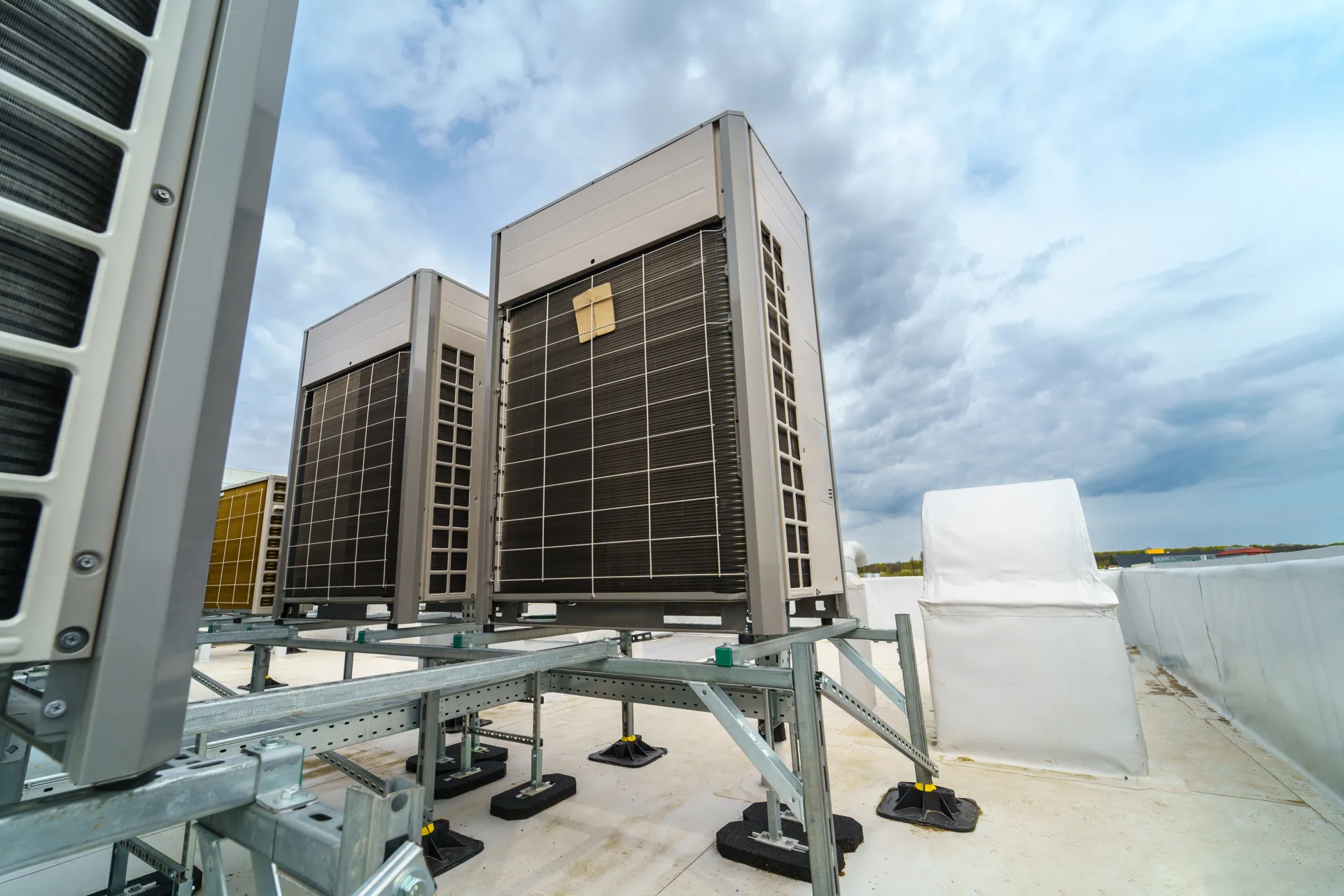
Rooftop unit (RTU) replacements represent another common retrofit. Standard efficiency RTUs operate at 8-10 EER, while high-efficiency units achieve 12-15 EER with variable-speed compressors and fans. When replacing RTUs, consider economizers that provide free cooling during mild weather—Ontario's climate offers significant economizer hours.
HVAC retrofit cost savings Toronto condo boards achieve are often greatest from fan coil unit replacements. Fan coil unit replacements are among the most common retrofits in GTA condo towers. Many buildings constructed in the 1970s through early 2000s use two-pipe fan coil systems that are now reaching or exceeding their 25-year expected lifespan. Failing fan coil motors, corroded drain pans, and leaking control valves generate constant maintenance calls and resident complaints. When planning a building-wide fan coil replacement program, property managers face the logistical challenge of accessing hundreds of individual suites while minimizing disruption to residents. HVAC Touch specializes in this work — see our condo fan coil repair and replacement services for GTA condo buildings.
A phased approach — replacing units floor by floor over several months — allows the building to maintain HVAC service while systematically upgrading the entire system. Modern fan coil units feature ECM (electronically commutated motor) blowers that consume 50 to 70 percent less electricity than older PSC (permanent split capacitor) motors, significantly reducing operating costs across the building. Upgrading from two-pipe to four-pipe fan coils during the replacement eliminates the seasonal changeover headache and allows simultaneous heating and cooling, though this requires additional piping infrastructure that may increase project costs substantially.
Advanced Controls and Automation Upgrades
Modern HVAC control systems (BAS) deliver rapid payback through optimized operation. Direct digital controls (DDC) replace pneumatic systems that drift out of calibration and lack scheduling flexibility. DDC provides precise control, remote monitoring, and detailed trend logging that identifies additional optimization opportunities.
Variable frequency drives (VFDs) on pumps and fans reduce energy consumption dramatically. Fan affinity laws indicate that reducing fan speed by 20% cuts power consumption by approximately 50%. Most commercial buildings have constant-volume air handlers and pumps—adding VFDs and upgrading to variable-air-volume (VAV) operation typically saves 30-50% fan energy.
Advanced scheduling eliminates waste from unoccupied operation. Many buildings run HVAC systems 24/7 despite 8-10 hour actual occupancy. Smart occupancy sensors, access card integration, and calendar-based scheduling automatically adjust operation based on actual building usage. After-hours override charges encourage tenants to minimize unnecessary HVAC operation.
Ductwork and Air Distribution Improvements
Duct sealing provides surprising energy savings. Studies indicate commercial buildings typically leak 15-25% of supply airflow through duct joints and connections. Aeroseal technology seals ducts from the inside, reducing leakage to under 5% with minimal disruption. For buildings with accessible ductwork, manual mastic sealing provides similar benefits.
Duct insulation improvements reduce thermal losses and gains. Uninsulated ductwork running through unconditioned spaces wastes enormous energy. Toronto building code requires R-8 insulation for supply ducts and R-6 for return ducts in unconditioned spaces—many older buildings have no insulation or degraded insulation that needs replacement.
Air balancing ensures proper distribution. Many buildings have never been properly balanced since original construction. Over time, dampers stick, belts slip, and systems drift. Test and balance (TAB) contractors measure airflow at all terminals and adjust dampers to design requirements. Proper balancing eliminates simultaneous heating and cooling while improving comfort.
Ventilation and Indoor Air Quality Enhancements
Dedicated Outdoor Air Systems (DOAS) decouple ventilation from heating and cooling. Traditional systems supply conditioned outdoor air through the same air handler providing space conditioning—a constant challenge given opposing requirements. DOAS units precondition outdoor air separately, handling dehumidification and heating/cooling before delivering neutral air to terminals.
Energy recovery ventilation (ERV) captures energy from exhaust air to precondition incoming outdoor air. During winter, ERV transfers heat from warm exhaust air to cold incoming air—during summer, the process reverses, cooling and dehumidifying incoming air. Modern enthalpy wheels transfer both sensible heat and latent heat (moisture), achieving 70-80% effectiveness.
Advanced filtration upgrades improve indoor air quality without excessive pressure drop. High-MERV filters (MERV 13-15) capture fine particles without requiring major fan upgrades when paired with low-pressure-drop designs. Bipolar ionization and UV-C systems provide supplemental air cleaning, reducing pathogens and VOCs.
Make-up air unit upgrades represent a particularly impactful retrofit opportunity in GTA condo buildings. Many older towers rely on make-up air units (MUAs) that supply tempered outdoor air to corridors for pressurization. These units often operate with constant-volume fans and basic temperature controls, running 24 hours a day regardless of actual building conditions. Retrofitting MUAs with variable frequency drives, demand-controlled ventilation based on corridor pressure sensors, and energy recovery wheels can reduce heating and cooling energy for ventilation air by 50 to 70 percent.
Given that ventilation typically accounts for 25 to 40 percent of total HVAC energy in high-rise residential buildings, MUA retrofits frequently deliver the fastest payback of any single upgrade. Modern MUA controls can also integrate with the building's fire alarm system to provide smoke control and pressurization functions during emergency events, an important safety consideration for buildings that must comply with Ontario Fire Code requirements for high-rise structures. TSSA-certified technicians should be involved in any MUA retrofit that involves gas-fired heating components, as modifications to fuel-burning equipment require permits and inspections under Ontario's Technical Standards and Safety Act.
Retrofit Implementation Best Practices
Phased implementation minimizes disruption. Most buildings cannot shut down HVAC systems for complete replacement—tenants require continuous service. Plan retrofits in phases, completing one system or zone at a time. Summer provides opportunities for heating system upgrades—winter allows cooling system replacements. Temporary equipment maintains service during major shutdowns.
In GTA condo buildings, phased implementation requires particularly careful coordination with property management and residents. Condo boards must approve major retrofit expenditures, often requiring special meetings and reserve fund allocations under Ontario's Condominium Act. Communication with unit owners about scheduled outages, access requirements for in-suite work, and construction noise is essential for maintaining resident satisfaction during multi-month retrofit projects.
Experienced HVAC contractors working in the GTA high-rise market understand these coordination requirements and build them into project timelines. Elevator booking for equipment deliveries, security protocols for contractor access, and after-hours work scheduling to minimize noise disturbance are all logistical considerations that separate residential tower retrofit specialists from general commercial HVAC contractors.
Commissioning ensures retrofits perform as designed. Many retrofits fail to achieve expected savings due to improper installation or control issues. Hire a commissioning agent to verify equipment installation, test control sequences, and document performance under various operating conditions. Recommissioning existing systems alongside new retrofits often reveals additional savings opportunities.
Measurement and verification (M&V) confirms savings achievement. Install metering on major equipment before and after retrofits to quantify energy reduction. Compare current consumption to baseline periods with weather normalization to account for variations. Document actual savings versus projections to build credibility for future retrofit investments.
Financing and Incentive Programs for Ontario Retrofits
Ontario offers several financial incentives that can significantly improve the return on investment for HVAC retrofits in Ontario. The Canada Greener Homes Grant and various municipal programs provide rebates for energy efficiency upgrades including high-efficiency boilers, heat pumps, and building envelope improvements. Enbridge Gas offers incentives for commercial customers who upgrade to high-efficiency natural gas equipment, including condensing boilers and demand-controlled ventilation systems. Toronto Hydro's commercial conservation programs provide incentives for VFD installations, lighting-integrated HVAC controls, and chiller optimization projects.
Property managers should explore these programs early in the retrofit planning process, as applications often need to be submitted before work begins and some programs have annual funding caps. For condo corporations, the reserve fund study process required under Ontario's Condominium Act provides a natural planning framework for scheduling major HVAC retrofits. By aligning retrofit investments with the reserve fund contribution schedule, condo boards can fund significant improvements without imposing special assessments on unit owners. Working with an HVAC contractor who understands these incentive programs and can assist with applications streamlines the process and ensures maximum financial benefit from the retrofit investment. For more on managing the full scope of condo HVAC projects, visit our property management HVAC services page.
20-40%
Energy savings from retrofits
3-7 years
Typical payback period
15-25 years
Equipment lifespan
Key Takeaways
- Assess existing equipment condition and comfort complaints before planning retrofits
- VFDs and control upgrades often provide faster payback than equipment replacement
- Energy recovery ventilation provides excellent ROI in Ontario's climate
- Commissioning and measurement ensure retrofits achieve projected savings
Related Topics
Ready to Modernize Your HVAC System?
Our retrofit experts assess your building, identify opportunities, and deliver comprehensive modernization plans with guaranteed ROI.
Schedule Retrofit Assessment